

Ever wondered where chatbots get their answers? They don’t just magically know things. They learn through a detailed, multi-step training process.
They start with huge amounts of data. This data teaches them about language, context, and what people mean. It’s like learning a new language.
Chatbots use many chatbot data sources to learn. These include special databases, web searches, and APIs. They also learn from how users interact with them.
The idea becomes more practical when you connect it to to deploy chatbots for maximum impact in a real conversational-AI workflow.
Behind it all are machine learning and Natural Language Processing (NLP). These technologies turn data into useful knowledge. This article will dive into how chatbots get their smarts.
Understanding the Fuel: What is Chatbot Training Data?
Chatbot training data is the key material for AI to learn human language. It’s a huge collection of text, dialogue, and info that machine learning models use to find patterns and understand context. Without it, a chatbot can’t have real conversations.
This data is like a school curriculum for AI. It includes articles, books, forum talks, and customer service chats. The model learns not just words but also grammar, reasoning, and cultural details.
The Role of Data in Machine Learning
In machine learning, models learn from examples, not rules. Chatbots use two main paths: supervised learning or self-supervised learning.
Supervised learning uses labelled data. The model is shown examples with the right answers. For example, a customer service bot learns from thousands of labelled chats. This method is great for specific tasks like understanding user intent.
Self-supervised learning is used by chatbots like ChatGPT. They learn from huge amounts of unlabelled text. It’s like learning a language by reading lots of books and figuring out the rules.
| Learning Type | Core Method | Primary Use in Chatbots | Data Characteristic |
|---|---|---|---|
| Supervised Learning | Learns from labelled input-output pairs. | Specialised tasks (e.g., ticket classification, sentiment analysis). | Requires carefully curated, labelled datasets. |
| Self-Supervised Learning | Learns by predicting masked or subsequent words in text. | Building general-purpose, foundational language models. | Leverages enormous volumes of unlabelled text from the web. |
Quality vs. Quantity: The Data Imperative
For years, AI focused on “a lot helps a lot.” But now, quality is more important. A model trained on a lot of bad data will often do worse than one with less but better data.
Good data should reflect real-world scenarios. If the data is biased or contains errors, the model will learn bad things. It’s important to have diverse, accurate, and clean data.
The principle of “garbage in, garbage out” is very true for AI. The model can’t be better than its training data.
The goal is for the model to generalise, not just memorise. Clean, diverse, and accurate data is essential for a reliable chatbot. So, modern development focuses on filtering, deduplication, and bias reduction before training.
Where Did Chatbot Get Its Data: The Primary Sources
Modern chatbots get their smarts from huge amounts of data. This data comes from two main places. The first is the vast, unstructured digital world of the internet. The second is high-quality, curated collections that are often exclusive.
Understanding this mix helps us see what chatbots can do and what they can’t.
The Vast Expanse of the Public Internet
Most of a chatbot’s knowledge comes from the internet. Developers use web crawling and scraping to gather this text. This process gives chatbots a wide range of human language and knowledge.
Common Crawl: The Internet’s Archive
The Common Crawl dataset is a key resource for AI. It’s a huge, open collection of web page data. This dataset offers trillions of words from billions of pages, giving models a solid base in language and facts.
Encyclopaedic and Forum Knowledge
Specific websites are also very valuable. Sites like Wikipedia offer detailed, factual information. Forums and social media platforms add conversational data and slang. This mix helps chatbots learn formal and informal language.
Licensed and Proprietary Datasets
For better data, developers use curated datasets. These are cleaner and more reliable, focusing on specific areas. They are often obtained through licences or partnerships, showing a big investment in quality.
Academic and Literary Corpora
For advanced knowledge, models are trained on academic papers and books. These sources offer precise terms and creative styles. Getting access to these often requires agreements with publishers or institutions.
Private Data Repositories
Some companies use their own data to improve models. This includes internal documents and customer service chats. These datasets are very valuable, giving chatbots a unique edge.
| Source Type | Primary Examples | Key Characteristics |
|---|---|---|
| Public Internet | Common Crawl, Wikipedia, forums | Massive scale, diverse, publicly accessible, can contain bias and inaccuracies. |
| Licensed & Proprietary | Academic journals, book corpora, internal company data | High-quality, curated, domain-specific, often requires legal agreements for use. |
This approach answers the question of where does chatbot get its information. The internet gives breadth and currency. Licensed datasets add depth and reliability. The chatbot’s knowledge is a mix of these digital libraries.
Methods of Data Collection and Sourcing
Every conversational AI needs a lot of data. This data is gathered in a way that balances speed with careful choice. We look at how this data is collected, as it affects the AI’s knowledge and ethics.
Large language models (LLMs) get their data through a mix of automated and human efforts. This mix is key for their learning. It helps them understand and act like humans.
Web Crawling and Scraping
Web crawling is like sending many librarians to copy every book. Automated programmes, or crawlers, search the internet.
They follow links, indexing and taking text from websites. This process, web scraping, gathers a huge amount of data from various sources.
This method gives the AI a lot of text to learn from. It helps the AI understand language, facts, and culture from different writings.

- Quality Variance: The data includes everything from top articles to casual blogs.
- Legal Grey Areas: Scraping must deal with copyright laws and website rules, which keep changing.
- Structural Noise: The text often has menus and ads that need to be removed.
Despite these problems, web crawling is vital. It’s the main way to get the wide range of data needed for self-supervised learning in LLMs.
Curated Datasets and Partnerships
Curated datasets are different. They focus on quality and permission. These datasets are carefully chosen, cleaned, and organised.
They come from researchers, non-profits, or companies. They offer valuable, structured data that’s hard to find online.
Getting this data often means working with content owners. This includes:
- Publishers of scientific journals and academic textbooks.
- News archives and media libraries.
- Companies with special technical documents or code.
These partnerships give legal access to important content. The data is usually accurate and free from harmful content.
The table below shows the main differences between these two methods:
| Method | Primary Process | Scale & Speed | Best For |
|---|---|---|---|
| Web Crawling/Scraping | Automated extraction from public websites. | Extremely high volume, fast collection. | Building broad linguistic understanding and general knowledge. |
| Curated Datasets & Partnerships | Manual selection and licensed acquisition. | Lower volume, slower, more resource-intensive. | Injecting specialised, high-quality, and legally compliant knowledge. |
To train a smart chatbot, we need both methods. Web crawling gives the AI a big base. Curated datasets and partnerships add the important details for a complete picture in the large language model.
Cleaning and Preparing the Raw Material
Imagine trying to teach a student with a library full of duplicated books, missing pages, and harmful messages. This is what raw scraped data looks like. Before it can help a chatbot, it needs a thorough transformation. This stage, called data preprocessing, is key to machine learning. It turns messy data into a clean, structured set ready for training.
Deduplication, Filtering, and Toxicity Removal
The first step in data preprocessing is to remove duplicates, filter out bad content, and get rid of harmful messages. These steps make sure the model learns from good, diverse, and safe information.
Deduplication removes texts that are the same or very similar. This stops the model from getting biased towards repeated phrases. It also makes training faster by removing unnecessary information.
Filtering acts as a quality check. It ensures the text is correct and relevant. It removes things like computer code or data tables that are not needed.
The most important step is toxicity removal. Special tools scan the text to find and remove harmful content. This is essential for creating a responsible and safe AI assistant.
Tokenisation: Converting Text to Numbers
After cleaning the data, it needs to be turned into numbers for the model to understand. This is where tokenisation comes in. It breaks down text into smaller, manageable pieces called tokens.
A token can be a word, part of a word, or even a single character. For example, “unhappiness” might be split into “un”, “happi”, and “ness”. Each unique token gets a unique number.
This step is vital. Neural networks work with numbers, not words. Tokenisation turns human language into numbers the model can learn from.
Different ways of tokenising offer different trade-offs. The table below shows some common methods.
| Tokenisation Method | Description | Example Input: “Chatbots learn.” | Pros & Cons |
|---|---|---|---|
| Word-Level | Splits text on spaces and punctuation. Each word becomes a token. | [“Chatbots”, “learn”, “.”] | Simple, but vocabulary can be huge and cannot handle unseen words. |
| Subword (e.g., Byte-Pair Encoding) | Splits words into frequent sub-units or characters. Balances vocabulary size and flexibility. | [“Chat”, “bots”, “learn”, “.”] | Can encode rare words and is commonly used in modern models like GPT. |
| Character-Level | Each character becomes a token. | [“C”, “h”, “a”, “t”, “b”, “o”, “t”, “s”, ” “, “l”, “e”, “a”, “r”, “n”, “.”] | Tiny vocabulary, but sequences are very long and computationally expensive. |
The choice of tokenisation method affects the model’s performance and efficiency. It’s a key decision in the data preprocessing pipeline. After tokenising, the numbers are ready for the neural network to start learning.
The Core Training Phases: From Foundation to Specialisation
Turning raw data into a chatbot is a step-by-step process. It starts with a broad understanding of language. Then, it refines this knowledge into a useful and safe assistant.
Pre-training: Building the Foundational Model
The pre-training phase is like teaching the AI the basics of language. It learns from a huge amount of text. This phase uses lots of computer power but lays a strong foundation.
The Architecture: Transformer Models
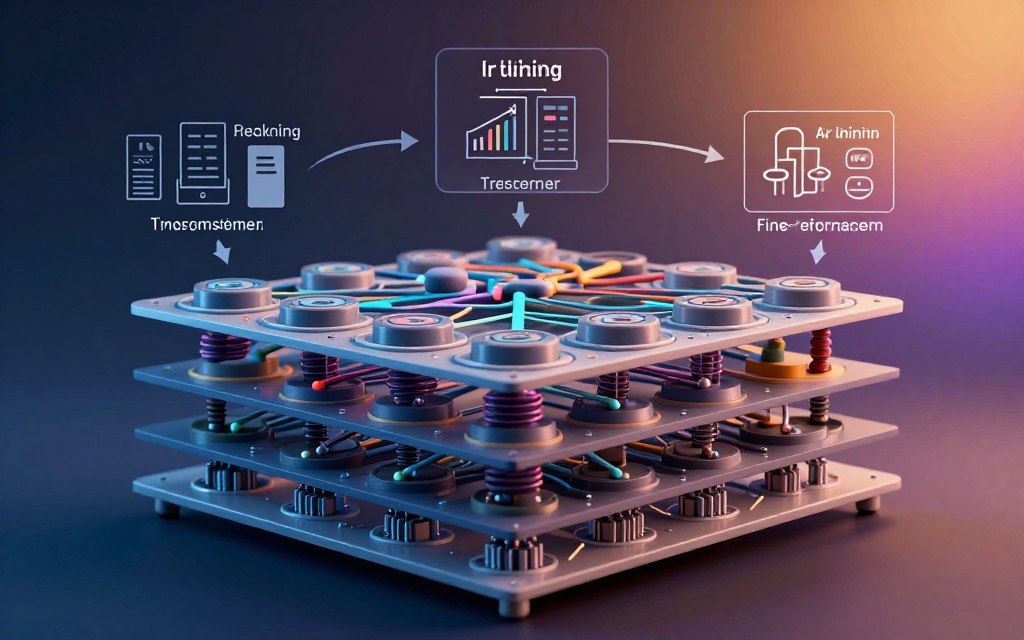
Most chatbots today use the Transformer architecture. This design, introduced in 2017, focuses on ‘attention’. It helps the model understand sentences better, no matter the word order.
The Learning Objective: Predicting the Next Token
In pre-training, the model tries to guess the next word in a sentence. It does this millions of times. This way, it learns about language patterns and facts.
Fine-Tuning: Aligning with Human Preferences
A pre-trained model can generate text but isn’t a helpful chatbot yet. Fine-tuning AI makes it better. It trains the model on smaller, high-quality datasets to meet specific goals.
Supervised Fine-Tuning (SFT)
Supervised Fine-Tuning is the first step in fine-tuning. The model learns from example conversations. Human trainers provide prompts and ideal responses, helping the model improve.
Reinforcement Learning from Human Feedback (RLHF)
Reinforcement Learning from Human Feedback (RLHF) is a more advanced method. AI trainers rank responses to prompts. The model is then fine-tuned to match these rankings, leading to better behaviour.
The table below shows the main differences between these phases and their parts:
| Training Phase | Primary Goal | Key Technique | Data Used | Primary Outcome |
|---|---|---|---|---|
| Pre-training | Build a general understanding of language patterns and world knowledge. | Next-token prediction using Transformer architecture. | Massive, unlabelled text corpus (e.g., web pages, books). | A foundational language model (e.g., GPT base model). |
| Supervised Fine-Tuning (SFT) | Learn a conversational style and format. | Supervised learning on demonstration data. | Curated datasets of human-written prompts and ideal responses. | A model that can engage in basic, helpful dialogue. |
| Reinforcement Learning from Human Feedback (RLHF) | Align model behaviour with nuanced human values (helpful, harmless). | Reinforcement learning optimised against a human preference model. | Human-ranked comparisons of model outputs. | A polished, safer, and more aligned conversational AI. |
These phases work together to create a powerful method. The pre-training phase gives the AI its knowledge. The fine-tuning steps, like RLHF, add the AI’s personality and safety. This makes models like ChatGPT both smart and helpful.
Challenges and Ethical Considerations in Data Sourcing
The search for big datasets to train AI models hits a wall with copyright laws and bias. Developers face a world of legal grey areas and big ethical questions. How we source and use data affects the fairness, reliability, and legality of AI systems.
Copyright, Fair Use, and Intellectual Property
Using copyrighted material from the web is a big legal issue. Most AI models are trained on huge amounts of text and images from public places. The idea of fair use is often used as a defence, saying training is a new, non-expressive use. But, this is a hotly debated topic, with no clear answers in many places.
Authors, artists, and media companies are suing over this. They say there’s huge copyright infringement without permission, credit, or pay. These lawsuits could change how AI companies get their data, maybe needing licences or permissioned content.
This legal uncertainty is risky for developers and users. It challenges the base of models built on widely scraped data. We need clear rules and AI data governance to know what’s okay for training.
Bias, Representation, and Hallucination
Ethical worries are deeper than legal ones. AI bias shows the biases in its training data. If data has prejudices, the model will learn and show them. This can lead to unfair outputs, like biased hiring or offensive language.
There’s also a problem of representation. Some groups or languages are over-represented, while others are not. An AI trained mostly on English from certain areas will struggle with global culture. It’s key to have diverse and representative data for fair AI.
Another big issue is “hallucination,” where chatbots make up plausible-sounding but wrong info. This happens because the model guesses word sequences, not from verified facts. If it’s trained on wrong or outdated data, it might share it as true. This shows the danger of using unverified data as knowledge.
| Challenge | Primary Cause | Mitigation via AI Data Governance |
|---|---|---|
| Copyright & Intellectual Property Infringement | Use of scraped, copyrighted content without explicit licences under fair use claims. | Developing clear data provenance policies, pursuing content partnerships, and investing in synthetic or licensed data. |
| Bias & Under-representation | Training data that reflects and amplifies historical and societal prejudices. | Implementing rigorous bias detection audits, curating for dataset diversity, and applying debiasing techniques during training. |
| Hallucination & Misinformation | Models generating information based on statistical patterns in unverified or outdated source data. | Improving data quality filtering, implementing real-time fact-checking layers, and clearly communicating model limitations to users. |
Dealing with these challenges is not just a choice; it’s essential for trustworthy AI. Good AI data governance—covering legal rules, ethical data, and quality checks—is key. Now, we’ll look at how top AI companies handle these issues.
Case Studies: Examining Real-World Chatbot Training
Chatbot training comes to life when we look at how top companies do it. By studying two big systems, we see how ideas turn into working AI.
OpenAI’s ChatGPT and the GPT Family
OpenAI’s path to ChatGPT shows how to grow data and models. They started with strong foundation models. Then, they made these into chat agents.
GPT-3’s Dataset Composition
The GPT-3 training data was huge and varied. It used hundreds of gigabytes of text from many sources. This included Common Crawl’s vast internet snapshot.
They cleaned and sorted this data. It also included books, academic papers, and all of English Wikipedia. This made a model with broad, if basic, knowledge.
The ChatGPT Refinement Process
ChatGPT development didn’t start from zero. It used a GPT model, fine-tuned with Supervised Fine-Tuning (SFT). Humans played both roles in conversations.
Then, Reinforcement Learning from Human Feedback (RLHF) was key. Trainers ranked responses, teaching the AI to be helpful and safe.
Google’s Bard (Gemini) and its Data Advantage
Google’s method is unique because of its access to special data. Unlike others, Google uses its own data, not just web scraping.
Leveraging the Google Ecosystem
Google’s big advantage is its own data. This includes its search index and YouTube. It also uses Google Books, Maps, and Scholar.
This data is diverse and always up-to-date. It’s hard for others to match.
The PaLM and Gemini Pathways
The Google PaLM model was a big step. It was trained on high-quality data to be good at reasoning and coding. Gemini models evolved from PaLM, designed for many types of data.
Gemini can handle text, code, audio, images, and video at once. This shows how good data can lead to advanced AI.
The Future of Chatbot Training Data
Two big trends are changing how chatbots learn. These are the growth of machine-made training examples and a new openness about data origins. The aim is to make AI more reliable and ethical, moving beyond just web scraping.
Future chatbots will be built from different materials and under closer scrutiny. This change is driven by the need for better, more trustworthy AI.
Synthetic Data and Data Generation
Synthetic data generation is a promising shift. AI models create new, artificial training data. This means chatbots won’t just rely on internet text.
Creating synthetic data has many benefits. It helps with data scarcity for specific tasks. It also allows for balanced datasets, reducing biases. Plus, it can exclude personal details, improving privacy.
But, there are risks. Models trained on their own data can develop flaws. There’s also debate about whether AI can truly match human language.
The goal is to use synthetic data alongside real-world data. It’s best for filling gaps and teaching specific skills.
Increased Transparency and Data Governance
There’s a growing push for transparency in AI. The current lack of openness is unsustainable. This is why AI data governance is becoming more important.
Detailed datasheets are a key part of this. They’re like nutritional labels for datasets. They show where the data comes from and what it contains.
This transparency has many benefits. It lets researchers check systems for fairness. It helps developers choose the right data. And it builds trust by making AI development clearer.
The future of data governance will include standardised reporting and possibly laws. Companies that embrace openness will lead in responsible AI. The secret training recipe days are numbered.
Conclusion
A chatbot’s knowledge comes from a complex process. It starts with gathering data from many sources. These include the internet, licensed data, and business secrets.
Then, this data is cleaned and prepared for machine learning. The training process has two main parts: pre-training and fine-tuning. Pre-training teaches the model about language patterns.
Fine-tuning makes the model more useful by adding human feedback. Modern AI, like OpenAI’s ChatGPT, can even use real-time data and remember conversations.
Understanding how chatbots are made is key to using AI responsibly. The type of training data affects how well a chatbot works. It also raises questions about bias and ethics.
Creating a better future for chatbots means improving data management. We also need new ways to generate data, like synthetic data.
In the end, a chatbot’s smarts are built step by step. Its abilities and limits show what it’s been trained on. Knowing this helps us use chatbots better and build a more reliable AI future.


 By
By